
 May 28, 2026
  6 min read
Most organisations only recognise their best people after they have already left. By the time a high-potential employee is visible to leadership, they may already be fielding offers from competitors. The earlier you identify them, the more time you have to develop, retain, and promote them, before someone else does.
Identifying high-potential employees is a strategic advantage, not an HR formality. Research shows that top performers in complex roles generate output that is far disproportionate to their numbers. Yet most organisations rely on gut feel, line manager feedback, or annual performance reviews to spot them — tools that measure past behaviour, not future potential.

The financial case for acting early is stark. According to the Society for Human Resource Management (SHRM), replacing an employee typically costs between 50% and 200% of their annual salary, once recruitment, onboarding, and lost productivity are included. For specialist or senior roles, the figure is higher. The cost of identifying a high-potential employee late — or not at all — is not hypothetical. It is the salary you keep paying while that person quietly disengages, and the replacement cost you absorb when they eventually leave.
Organisations are increasingly failing not because they hire too slowly, but because they hire inaccurately. Roles get filled, but when people are placed into positions that do not match their abilities, motivation, or working style, problems appear quickly: productivity drops, engagement fades, and good employees leave. Not because they lack skill, but because the role was never the right fit from the start.

High Potential Is Not the Same as High Performance
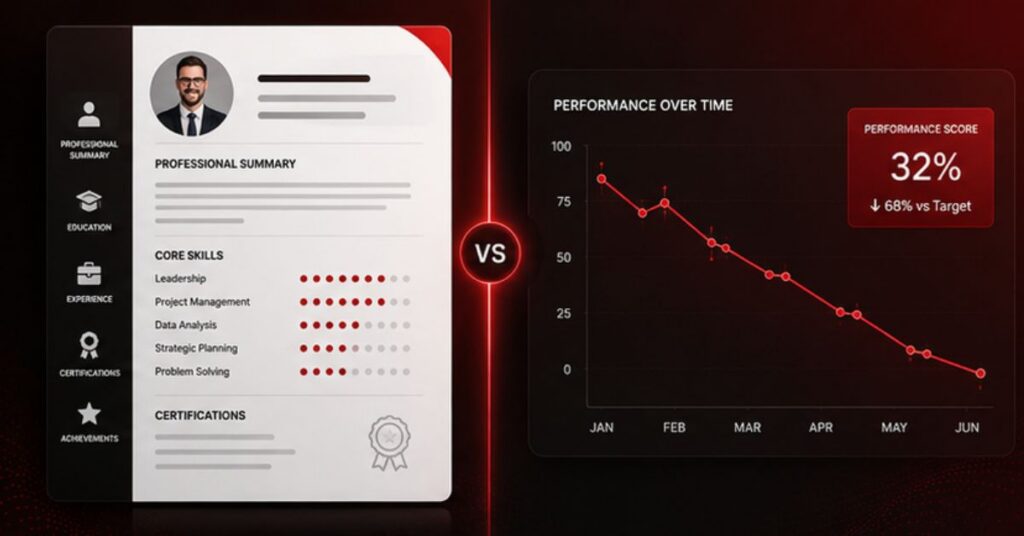
This distinction matters enormously, and most organisations miss it. CEB (now Gartner) found that only around 15% of high performers are also high-potential employees. Strong current performance does not automatically predict future leadership capability — meaning some of your most future-ready employees may not yet be your strongest current performers.
True high-potential employees show three characteristics:
- the aspiration to take on greater responsibility
- the ability to handle increased complexity
- the engagement to act in the organisation’s long-term interest
Here is what each looks like in practice, and how to measure it before it becomes obvious:
Learning agility is the ability to absorb new information quickly and apply it where no precedent exists. These employees pick up new systems fastest, ask questions others haven’t formed yet, and adapt without waiting for direction. GoPick’s Learning Agility Profile measures this across four dimensions — People Agility, Mental Agility, Results Agility, and Change Agility — giving you an objective reading rather than a gut impression.
Cognitive capacity shows up not in how hard someone works, but in how they frame problems. High-potential employees spot consequences their peers miss and make sound judgements under pressure. GoPick’s Cognitive Ability Profile (CAP) delivers a norm-referenced measure of learning ability and problem-solving, benchmarked against relevant working populations so you know exactly where someone stands relative to role demands.
Drive and initiative define employees who don’t wait for permission. They spot gaps, propose solutions, and take ownership beyond what the role requires. GoPick’s Job Motivation Profile surfaces internal drivers and motivational intensity — showing not just whether someone can do the work, but whether they’ll push past it.
Tenacity under pressure separates those who grow through adversity from those who stall at it. These employees deliver under compressed deadlines, absorb setbacks without disengaging, and keep teams moving when others pull back. GoPick’s Tenacity Profile measures perseverance, goal orientation, and resilience — so you can identify who thrives when conditions get hard.

Where Traditional Talent Reviews Go Wrong
Most talent review processes rely heavily on line manager nominations. The result is a pipeline that reflects who is most visible, not who has the most potential. Three biases consistently skew these processes:
- Proximity bias means employees who work closely with their manager are more likely to be noticed regardless of underlying potential.
- Affinity bias means managers favour people who communicate in a similar style or share similar backgrounds.
- Recency bias means the employee who delivered a strong quarter gets nominated over someone showing steady growth across two years.
The fix is not to eliminate manager input, it is to structure it. Manager observations become far more reliable when they are captured against agreed criteria and complemented by objective assessment data.

A More Reliable Identification Process
The core talent question is shifting from “Who can we hire?” to “Who will actually fit, perform, and stay?” That same logic applies to internal identification — the question becomes not “Who is performing well now?” but “Who has the capacity to perform in roles that do not yet exist on the org chart?”
A structured approach replaces noise with signal. Here is what it looks like in practice:
- Define criteria before you review: Agree on what high potential means in your organisation before looking at individuals. Without agreed criteria, every manager applies a different standard. Define the competency framework first, then assess against it.
- Use validated psychometric assessments: Standardised tools provide objective data on the traits that predict future performance. They are administered consistently, scored without bias, and benchmarked against relevant populations.
- Triangulate your data: No single source tells the whole story. Combine assessment results with structured observations and multi-rater feedback. Multi-rater feedback surveys capture how employees are experienced by peers, direct reports, and leaders and allow to complement psychometric data with observable behavioural evidence.
- Make the process transparent: Employees who understand how high-potential identification works are more motivated to participate and more likely to stay when they are identified. Lack of transparency breeds resentment, particularly among overlooked talent who quietly disengage.

Acting on What You Find
Identifying a high-potential employee is only valuable if it changes something. A person who is identified but receives no change in their development experience will disengage faster than one who was never identified at all. Because now they know the organisation sees their potential and is choosing not to invest in it.
Development plans should be specific, not generic. Effective actions include stretch assignments, mentoring relationships with senior leaders, early involvement in strategic projects, and accelerated development pathways. The goal is to reduce the gap between current capability and readiness for the roles you need filled in two to five years.
The organisations that get this right treat high-potential identification not as an annual HR exercise but as a continuous, data-driven process feeding directly into succession planning and leadership investment decisions.
Key Takeaways
- High potential and high performance are not the same. Only around 15% of high performers are also high potentials.
- The most predictive traits, learning agility, cognitive capacity, drive, and tenacity, are measurable before they become obvious.
- Traditional manager-led reviews are skewed by proximity, affinity, and recency bias.
- Validated psychometric assessments provide consistent, benchmarked data that removes subjectivity from the process.
- Identification only creates value when it drives targeted, individualised development, not just an entry in an HR system.
Start Building Your High-Potential Pipeline With Confidence
Identifying high-potential employees early is one of the highest-return investments an HR team can make. The alternative — discovering your best talent after they have already been headhunted, promoted elsewhere, or quietly disengaged — is a cost that compounds year on year.
GoPick’s validated assessments give you the data to make those decisions with evidence, not instinct. Whether you are building a pipeline from scratch or adding rigour to an existing process, we can help.
Explore our Assessment Solutions:
https://gopicksolutions.com/assessment-solutions/
Speak with an HR Solutions Consultant:
https://gopicksolutions.com/contact-us/